Fixed rate tourist tax voted through in new Bill
26 March 2026
Holyrood passes new law on Visitor Levy
Perthshire accommodation providers could now have the option to charge a flat rate tourist tax after the Scottish Parliament passed the Visitor Levy (Amendment) (Scotland) Bill.
The Bill, voted through on Tuesday, was accelerated after tourism and accommodation bodies lobbied government to make changes to the original Visitor Levy Act which was passed in 2024.
That legislation gave local authorities the ability to charge a percentage on overnight stays but groups were highly critical, claiming it would be inconsistently applied across Scotland and would be costly and complex to administer.
Now, after listening to the tourism and accommodation sectors, Public Finance Minister Ivan McKee has successfully piloted an amended Bill which will offer councils greater flexibility to reflect the tourism marketplace in their own areas.
Key vote in June
Perth and Kinross Council is set to vote on the issue on June 17th and now has the ability to charge a flat rate fee on overnight stays, if it chooses to do so.
That would seemingly be a preferable option to businesses and the public who were overwhelmingly against the introduction of a tourist tax (68% voting against it in the authority’s consultation).
However, those swithering – perhaps seeing that new investment could be beneficial in terms of tourism promotion and infrastructure in Perthshire – were more likely to opt for a flat rate charge, if a levy was to be progressed.
Our own Perthshire Business News survey mirrored the Council’s consultation results almost exactly.
65% of our respondents opposed a levy, with the accommodation sector almost unanimously against it (93%).
However, 62% of respondents backed a fixed tariff, rather than a percentage fee, if a tourist tax was to go ahead. See the full Survey results, here.
What happens now?
The next step for Perthshire will be the key council vote in June. There, councillors will decide whether to introduce a tourist tax at all and, if approved, how they would apply it (percentage based or flat fee).
Should a levy win support, it could not be introduced earlier than 18 months from the decision date and would have to go to a full public consultation.
How accommodation providers would collect the tax would also have to be agreed, with systems put in place.
The new Bill, passed at Holyrood this week, has given councils the option to allow accommodation providers to keep a portion of the fee to cover the burden of administering the tax.
Councils would also have the ability to review the levy arrangement every 3 years.
Sector reaction
The country’s self-catering sector has backed the passing of the new legislation.
Fiona Campbell, Chief Executive of the Association of Scotland’s Self-Caterers, said: “The inclusion of enhanced flexibility through the option of a fixed amount model is a crucial step forward in delivering a fair and practical system for Scotland’s £1bn self-catering sector.”
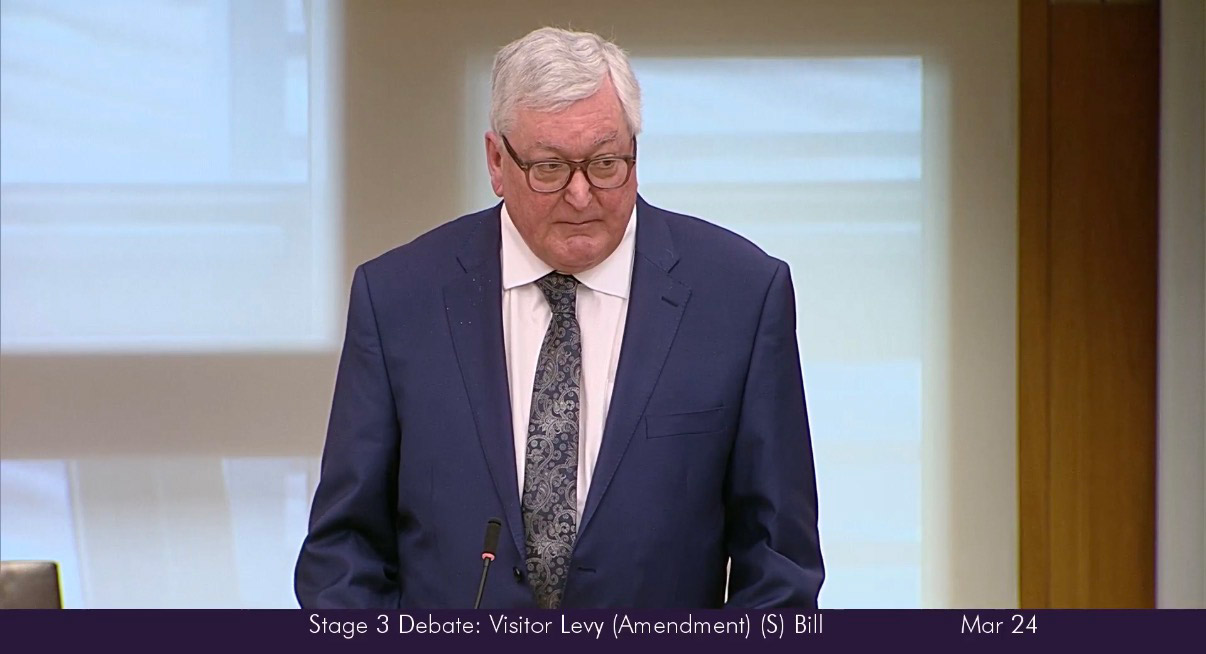 Fergus Ewing was highly critical of record on Tourism
Tourism policies criticised
A key moment in the Stage 3 debate on the Bill was the comments of former Tourism Minister Fergus Ewing MSP, who is set to stand as an Independent at May’s Holyrood election.
He voiced his disapproval at how the sector had been treated during this 5-year Parliamentary term and expressed hopes for better after the election.
“I am afraid this session of Parliament has, by any standards, been a session where the tourism sector has not been dealt a fair hand of cards and that is putting it very mildly indeed.”
Mr Ewing pointed to the Tourism levy as well as the business rates ‘fiasco’ as examples of where the Parliament, he felt, had let the sector down.
Do you agree? Let us know by writing to stories@perthshire.net and giving us your views.
Latest News